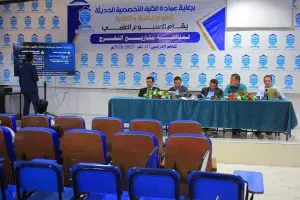
A graduation project for cybersecurity students a tool for detecting vulnerabilities in web applications
Web application vulnerability detection tool: Cybersecurity project
Between Computer Vision and Cybersecurity… Graduation Projects That Go Beyond Academic Boundaries to Knock on the Doors of Industry.
Saturday, 8 Dhul Qa’dah 1447 AH | Corresponding to April 25, 2026 AD
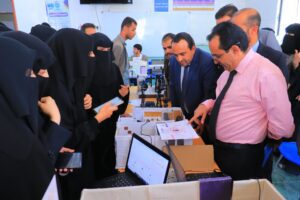
Today, the Modern Specialized College witnessed the continuation of graduation project defense sessions for the Applied Bachelor’s degree for the academic year 2025-2026 AD. These sessions were distinguished by presenting technical and innovative solutions that meet the needs of the job market in the fields of artificial intelligence and cybersecurity.
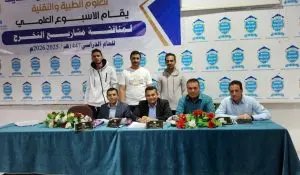
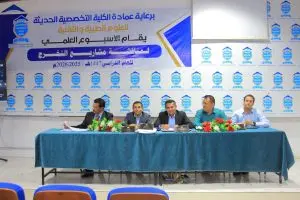
The discussion and judging committee was composed of specialized academic luminaries, including:
-
Prof. Dr. Adel Al-Shamiri (Discussant)
-
Dr. Fawaz Al-Ghafari (Supervisor)
-
Dr. Yahya Al-Samawi (Discussant)
In the second scientific session, the Cybersecurity Department presented a distinctive project titled:
“Advanced Security Scanning and Vulnerability Detection Tool for Web Applications – USS”
The project aims to provide a secure digital environment by identifying software vulnerabilities and protecting them from cyber breaches.
Project: Advanced Security Scanning and Vulnerability Detection Tool for Web Applications – USS
This project comes at a time when cyberattacks on applications and electronic platforms have increased, making web applications a primary target for hackers due to the sensitive user and corporate data they contain. The developed tool aims to provide a secure digital environment through systematic detection of software vulnerabilities before they can be exploited by attackers, in addition to suggesting immediate solutions and automatically addressing discovered vulnerabilities.
Project Importance and Results
The USS tool was designed to function as a proactive security scanner, relying on a continuously updated database of common attack patterns such as SQL injection, cross-site scripting (XSS), remote command execution, authentication bypass, and server misconfiguration. Unlike traditional tools that perform only surface-level scans, USS analyzes the application’s structure and its interactive elements (input forms, API links, session files) using fuzzing techniques and intelligent real-world attack simulation.
The tool features an interactive graphical interface that enables developers and security specialists to view a detailed report on the severity level of each vulnerability, its location in the code, and actionable recommendations for remediation.
In addition to detecting vulnerabilities, USS contributes to protecting organizations from cyber breaches by incorporating a continuous monitoring feature. It can be deployed as a background service (daemon) that scans new updates as soon as the application is deployed. The students concluded their presentation with a practical case study on an open-source content management system, where 12 security vulnerabilities were discovered within just ten minutes, including three critical vulnerabilities.
This project offers an economical and effective solution for startups and institutions seeking to secure their applications without the need for large security teams, reflecting the role of technical education in developing high-quality solutions to face the challenges of the digital age.
The committee praised the high scientific and technical level presented by the students, noting that these projects represent pioneering, practically applicable models. They affirmed the college’s role in linking educational outcomes with accelerating technological developments and qualifying cadres capable of competing in the local and regional job market.
related links:
more information about university: Modern Specialized University | The best university in Yemen
more information about university programs: University programs| Modern Specialized University



You may also like
IoT Security Projects Presented by Cybersecurity Students