
Outstanding Research in Biotechnology
A groundbreaking research achievement reflecting advanced scientific expertise in the field of biotechnology
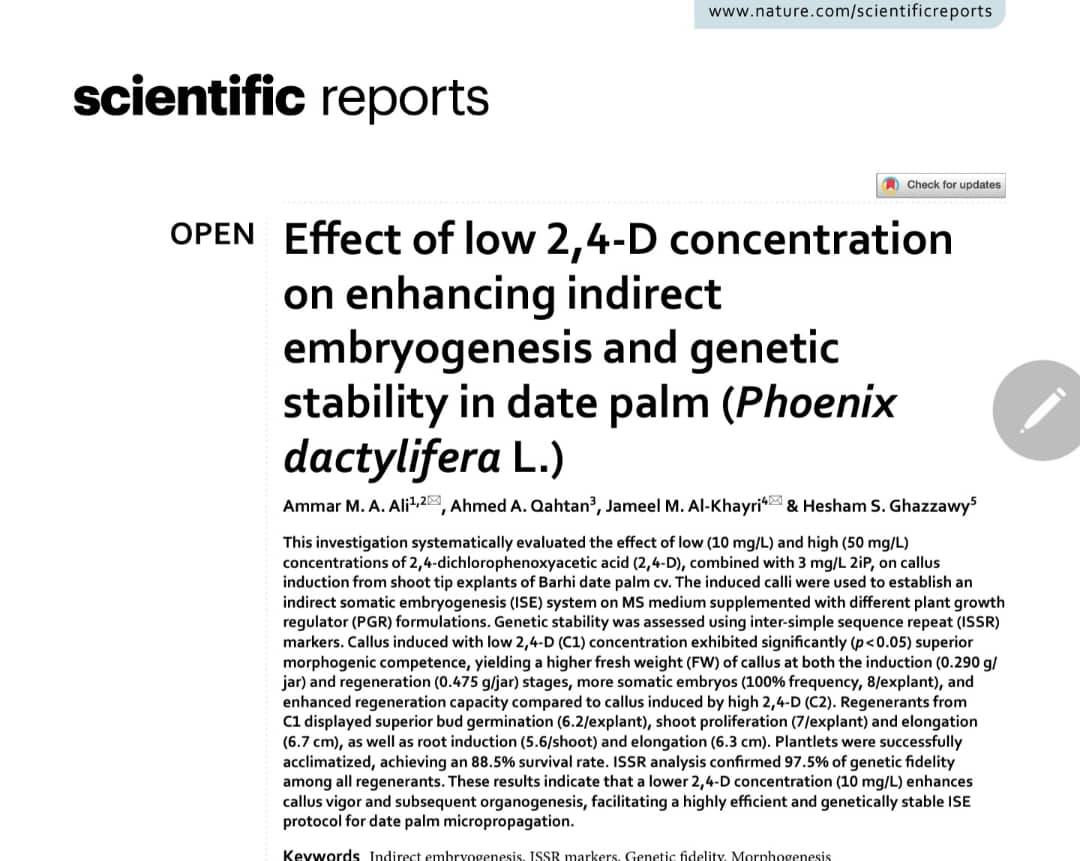
Amid global scientific competition to find innovative solutions to agricultural challenges, this research achievement stands out as one of the pioneering works that exemplify the standing of Arab scientific research in international forums. The scientific research was published in the prestigious journal Scientific Reports, published by the renowned global publisher Springer Nature, a journal ranked in the first quartile (Q1) of the Clarivate scientific citation ranking. This high ranking reflects the robustness of the research, the rigor of its methodology, and the value of its findings within the context of human knowledge, as the research undergoes rigorous peer review by experts in the field prior to publication, making its acceptance in the journal an international recognition of its quality and originality.
This scientific work is authored by Dr. Ammar Mohammed Ahmed Ali, in his capacity as first author and Dean of the Center for Academic Development and Quality Assurance, underscoring the ability of academic staff to actively contribute to addressing vital research issues alongside their leadership and developmental responsibilities. The research bears a precise title that reflects the essence of the innovation it presents:
“The Effect of Low Concentrations of the Growth Regulator 2,4-D on Improving Indirect Embryo Morphogenesis and Genetic Fingerprinting in the Barhi Date Palm.”
Significance and Results of the Study:
This study focuses on developing an effective in vitro protocol for the propagation of date palms using tissue culture techniques, a topic of critical importance given the challenges facing date palm cultivation, including soil degradation, the spread of diseases, and undesirable genetic variation, and the need to produce large numbers of genetically identical, high-quality plants. The results revealed that using a low concentration of the growth regulator 2,4-D, traditionally used to induce callus formation, can bring about a qualitative shift in the efficiency of micropropagation, as it contributed to:
- improving callus formation and increasing its viability, meaning a stronger and more consistent start to the in vitro propagation process.
- increasing the efficiency of somatic embryo formation by up to 100%, an exceptional rate for this type of technology, as the somatic embryo formation stage is the cornerstone of successful micropropagation.
- Promoting the growth and rooting of laboratory-propagated plants, thereby reducing waste and facilitating the transition of plants to the external environment.
Achieving high genetic stability in the resulting plants at a rate of 97.5%, which is a critical point because one of the greatest challenges in tissue culture is the occurrence of undesirable genetic variations (somaclonal variation). This high rate ensures that the produced plants retain the desired traits of the original parent.
The resulting plants also achieved a high survival rate of 88.5% when transferred to natural conditions, confirming the practical effectiveness of this technology and its transition from laboratory experiments to real-world production.
Impact of the Research and Future Directions:
This achievement represents a significant advancement that contributes to the development of agricultural biotechnology applications and enhances the use of scientific research to address production challenges and achieve sustainability. By offering a more efficient and less costly protocol (due to the use of a low concentration of growth regulator) and greater genetic stability, the research opens up broad prospects for the expansion of Barhi date palm cultivation, which holds significant economic and heritage value, and provides a practical solution to the problems of traditional propagation methods, which suffer from slow production and low efficiency.
This achievement is not merely a published research paper; it is a scientific message that serious, well-thought-out research—when grounded in rigorous methodology and research questions that address real-world problems—can achieve significant international impact and contribute to shaping a more sustainable future for food and agricultural security.
🔗 Link to the post:
[https://www.nature.com/articles/s41598-025-29924-0](https://www.nature.com/articles/s41598-025-29924-0)


You may also like


